If you need an ESP32 board in New Zealand this week, buy from a local seller that already has stock. AliExpress and other overseas marketplaces can look cheaper on the sticker price, but you should add delivery time, possible GST at checkout, the difficulty of returns, and the chance that the flash or PSRAM does not match the listing.
This is a buying guide, not a price comparison. Other shops change their range often, and we will not quote their prices. For which chip to choose in the first place, start with ESP32-S3 vs ESP32: which board to buy in NZ.
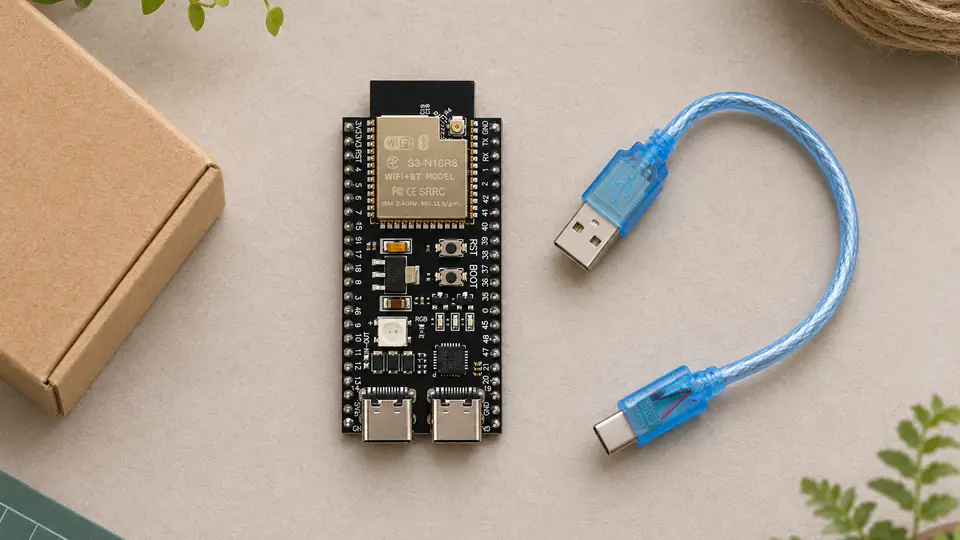
Cover illustration based on 3DGo product photos. The board and cable are sold separately.
Local New Zealand stock versus overseas marketplaces
You can buy an ESP32-class board in three broad ways.
Local electronics retailers and specialist shops
New Zealand electronics retailers and hobby specialists sometimes carry ESP32 development boards, often a classic ESP32 DevKit-style board rather than a specific ESP32-S3 N16R8 variant. Retailers such as Jaycar are an example of the first group; smaller specialist shops are another. Check the chip series, flash and PSRAM labels, and whether headers are fitted, before you visit or order. Availability changes, so look at the live listing rather than assuming a board is on the shelf.
Overseas marketplaces
AliExpress, Amazon and similar sites list a very wide range, including official-looking modules and unbranded copies of Espressif’s DevKit layouts. Posted delivery to New Zealand is often measured in weeks rather than days, and it stretches further around public holidays or peak sales. Faster shipping lines exist, but they change the total cost. A listing photograph is not proof of the memory fitted to the board in the bag.
3DGo — Auckland North Shore
We stock ESP32 boards in NZ, including the ESP32-S3 N16R8 dual USB-C board and the ESP32-S3 N16R8 board with pre-soldered headers. Courier delivery is available across New Zealand, and free pickup can be arranged in Torbay, Auckland. Current options are on the Delivery & Payment page.
As of 25 November 2026 (NZDT), those two boards are NZ$21.90 and NZ$24.90; check the product pages for the current price and stock. We do not currently list a classic ESP32 board. If you still need one for Bluetooth Classic or A2DP, a local electronics retailer or an overseas listing is the place to look.
Delivery time, GST and returns
Compare the delivered cost and the wait, not only the board price.
Delivery. A local order can arrive in a few days by courier, or the same day if you pick it up. An AliExpress or similar order often takes one to several weeks to reach New Zealand, sometimes longer. Amazon delivery depends on whether the item ships from a nearby warehouse or from overseas; read the listing’s delivery estimate rather than assuming a short transit time.
GST on low-value imports. New Zealand GST is 15%. A board bought from a NZ GST-registered seller is usually priced with GST included. For goods valued at NZ$1,000 or less, Inland Revenue treats them as low-value imported goods, and a registered overseas seller or marketplace may charge GST at checkout. New Zealand Customs does not normally collect duty or GST at the border on a shipment of NZ$1,000 or less, except for goods such as alcohol and tobacco. If several orders from the same supplier arrive on the same day, Customs may treat them as one shipment, which can push the total over that threshold. If the checkout price has no GST line, that does not mean GST never applies; it may only mean that particular seller is not charging it there.
Border levies. Customs also states that a Customs and MPI goods levy may be charged on imported consignments, and that a broker or freight forwarder may pass it on. The amount and the way it is collected depend on the mode of transport (air, sea or mail) and on current Customs rules, which changed again from 1 April 2026. Check the Customs page above rather than treating a forum figure as a bill.
Returns. For a local purchase, check the retailer’s returns process. New Zealand consumer guarantees apply to qualifying purchases from businesses selling to consumers. Returning a cheap board to an overseas marketplace often costs more than the part, and some listings are difficult to return at all. That matters if the flash or PSRAM is not what you paid for.
How to spot a mislabelled or poor-quality board
Many useful development boards are third-party copies of Espressif’s DevKit layout. A compatible layout is not, by itself, a fake. The problem to watch for is a listing that claims a memory size the hardware does not have — for example a board sold as N16R8 that only contains 4 MB of flash, or PSRAM that never appears when you enable it.
Before you order, read the module marking if the seller shows a clear photo. On Espressif-style modules, N16 is 16 MB of flash and R8 is 8 MB of PSRAM. After the board arrives, do not trust the silkscreen alone. Check the chip and the memory on the desk.
With esptool connected to the board’s serial port, run:
esptool chip-id
esptool flash-id
Older esptool versions use underscores instead of hyphens (chip_id, flash_id). Both forms should report the chip type (for example ESP32 or ESP32-S3) and a detected flash size. On a board sold as N16R8 you want a detected flash size of 16 MB. Some esptool versions also print in-package PSRAM in the chip features line; if that line is present, it should match the listing.
Then, in the Arduino IDE, set the board to ESP32S3 Dev Module with 16 MB flash and OPI PSRAM for an N16R8 S3, and run a short sketch that prints ESP.getFlashChipSize() and, if psramFound() is true, ESP.getPsramSize(). The getting-started guide includes a first-check sketch of that kind. You are looking for 16 MB of flash and a PSRAM figure a little under 8 MB. If PSRAM is “not found”, first confirm the Tools menu is set to OPI PSRAM rather than QSPI; a wrong setting can hide memory that is actually present. If the settings are correct and the size is still wrong, the board does not match the listing.
A missing or unreadable module marking, a flash size far below the advertisement, or PSRAM that never appears after the correct IDE settings are all reasons to stop and use the seller’s return process. The same check is worth running on a board bought locally.
A practical way to decide
- Buy locally when you need the board soon, want an easy return, or are buying one or two boards for a first project.
- Buy overseas when you can wait, have compared the delivered price including any GST or courier pass-through charges, and are prepared to verify the memory when the parcel arrives.
- Match the chip to the project. An ESP32-S3 N16R8 is the better default for new AI and IoT work. Choose a classic ESP32 for Bluetooth Classic or when an existing project depends on that chip. The comparison article above walks through that choice; a parts list for a voice-assistant build is in How to build an ESP32-S3 AI voice assistant.
If you want a board that is already in Auckland, start from the ESP32 range linked above, or pick one up in Torbay by arrangement.
About the import rules in this article. The GST and Customs points were checked against Inland Revenue and New Zealand Customs pages on 25 November 2026. Those rules can change, and a carrier may add its own handling fee.
For current prices and stock, see the dual USB-C N16R8 board and the N16R8 board with pre-soldered headers.