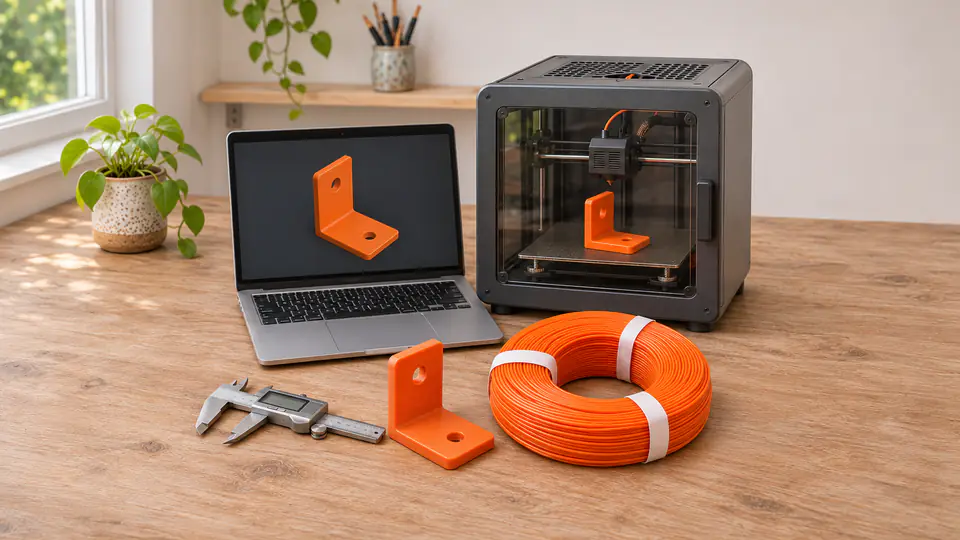
A text-to-CAD tool can turn a plain-English description into a file you can print. The useful work starts after the file appears: checking that the model is actually printable, choosing PETG when the part has a job to do, and running the first attempt from the settings on your spool’s label. This guide covers that second half, with PETG filament stocked in Auckland. It is not a review of any one plugin, and it is not a repeat of our ESP32-S3 enclosure tutorial, which is a measured OpenSCAD workflow for an electronics case. The tools change quickly; the print checklist does not.
What text-to-CAD is, and what it is not
In this article, “text-to-CAD” means any assistant or plugin that takes a written description and returns a solid model — STEP, STL, 3MF or similar — that a slicer can use. Some of those tools now plug into coding agents such as Claude Code or Codex. They can be a fast way to get a first shape. They do not inspect your printer, your filament or the part in your hand.
Treat the first export as a draft. It may look right in a preview and still have walls thinner than your nozzle can print, the wrong units, or gaps and inverted faces that a slicer silently repairs — or fails to. It has not been fitted to the real object unless you typed exact measurements and then checked them. If the part is an enclosure for a board you already own, use the measured OpenSCAD method instead. For a stand, a hook or a bracket, the rest of this article applies.
Check the model before you slice
Open the file in your slicer and in a simple model viewer, and walk through this list:
- Overall size. A phone stand that imports at 12 mm wide is almost certainly in the wrong units. Compare a known dimension to a ruler or to the object it should hold.
- Wall thickness. With a 0.4 mm nozzle, load-bearing walls are more reliable at 1.6 mm or 2 mm than at a generated 0.9 mm “thin shell”.
- Overhangs and bridges. A 45° chamfer or a modest bridge will often print; a wide, flat ceiling may need supports, or a redesign.
- Fillets on inside corners, especially on clips. A sharp internal corner is where a flexed PETG part likes to split.
- How it sits on the bed. Prefer a large, flat face down.
- Moving or mating parts. If two pieces must snap or slide, build in clearance (often around 0.2–0.3 mm per side) and print a short fit coupon first.
If something fails a check, take it back to the tool with a precise change (“increase the wall to 2 mm”), then re-check the new file. Do not keep reprinting a model you have not inspected.
When PETG is the right material
Use PETG when the part will be handled, flexed, clipped, or left in a warm room — a phone stand, hook, cable clip, bracket or desk easel. PLA remains reasonable for a display model or a disposable fit coupon. The differences are set out in PETG vs PLA. Store open PETG sealed with dry desiccant; see why and how to dry filament if a print starts stringing or looks foamy. A part that will sit in strong sun for months may still need a UV-resistant material or a coat of paint. Why we prefer PETG in Auckland covers that climate context.
Start from the label, then print a coupon
There is no single “best PETG profile” for every brand and printer. Start from the current label on the spool, a supported profile for your printer, and the series ranges in our PETG print settings guide. Those ranges are supplier or label references, not shop-tested results. Always check the label in the box:
| Series | Nozzle (starting reference) | Bed (starting reference) |
|---|---|---|
| Bambu Lab PETG Basic | 230–260°C | 65–75°C |
| greatsimple PETG HF | 225–255°C | 70°C |
| Tinmorry PETG-ECO | 220–240°C | 70–80°C |
| R3D 3 kg Off-White and Transparent | 230–250°C | Follow the current label |
| Other rolls | Follow the exact label | Follow the exact label |
High-flow (HF) PETG is worth considering when you are iterating quickly on a modern, fast printer and the hotend can actually use the extra flow. It is not required for a first stand, and the name does not, by itself, set a speed; see the PETG HF collection page. Print a coupon — a slice of the groove, hook or clip — before the full part. If you see fine hairs between features, work through PETG stringing. PETG can bond strongly to some build plates; follow the plate maker’s guidance, or see PETG bed adhesion.
What each packaging format costs, as of 22 November 2026
Once the model is worth printing more than once, packaging starts to matter. These figures are 3DGo listed prices as of 22 November 2026 (NZDT). They may include sale pricing and can change; confirm the live page before you order.
| Format | Example in our range | Listed price (22 Nov 2026, NZDT) | Cost per kg |
|---|---|---|---|
| 1 kg refill, typical HF colours | greatsimple PETG HF, most refill colours | NZ$19.90 | NZ$19.90 |
| 1 kg refill, Bambu Lab | PETG Basic White or Black | NZ$22.90 | NZ$22.90 |
| 1 kg with spool, everyday colours | R3D Economy in several colours; greatsimple HF Yellow, Red or Pink with spool | NZ$21.00–$21.90 | NZ$21.00–$21.90 |
| 1 kg with spool, lower-priced colours | Xibo Light Beige; Tinmorry PETG-ECO Pink | NZ$16.90–$18.90 | NZ$16.90–$18.90 |
| 3 kg large spool | R3D Off-White or Transparent | NZ$49.00 | NZ$16.33 |
A few colour-specific refill prices were lower than the typical HF figure on that date; treat those as the price of that colour, not the category average. Shipping is not included; check delivery.
A 1 kg roll with a spool is the straightforward first order if you do not already own a reusable spool. A refill is usually cheaper than the same brand on a disposable spool, and throws away less plastic, but you must fit it to a compatible reusable spool before you cut the securing straps. Use Bambu Lab’s own instructions for Bambu refills and Bambu reusable spools, and the refill maker’s instructions for any other brand; do not force a mismatched core. We stock PETG refills from Bambu Lab and greatsimple. A 3 kg spool is the lowest cost per kilogram in the table, but it needs a large holder and is heavier to move.
A simple print plan
- Put the critical measurement (phone width, hook pitch, pipe diameter) in the description you give the tool.
- Export the file, check the six points above, and fix the model before you slice.
- Load a supported PETG profile and the label temperatures.
- Print a coupon, fit the real object, then print the full part.
- Store the open roll sealed with desiccant.
If the part is a stand for an e-paper display or a tray for a weekend robot, measure the hardware and prefer a parametric case over a one-shot generated mesh.
Frequently asked questions
Is this the same as your AI enclosure guide?
No. The ESP32-S3 enclosure article is a measured OpenSCAD workflow for a specific board. This article is about checking and printing a model that already came from a text-to-CAD tool.
Should I print a phone stand in PETG or PLA?
PETG is the better default for a stand that will be handled every day and may sit near a window. PLA is fine for a quick fit check. See PETG vs PLA.
The generated model has 0.8 mm walls. Can I just print it anyway?
A load-bearing 0.8 mm wall on a 0.4 mm nozzle is a weak starting point. Ask the tool for 1.6 mm or 2 mm walls and compare a coupon. A slicer setting cannot always invent material the model does not have.
Do I need high-flow PETG?
Only if your printer is running at speeds where regular PETG would struggle to melt fast enough. For a first stand on a moderate profile, a regular or Basic PETG is enough. Browse PETG HF if you already print quickly.
Which should I buy for a first order from Auckland?
If you do not have a reusable spool, choose a 1 kg PETG roll with a spool. If you already have a compatible reusable spool, a refill is usually the tidier option. Check live stock; some colours run thin.
About the figures in this guide. The temperature table restates supplier or label references already used on our product and guide pages, current as of the dates on those pages. Always follow the label in the box. Prices in the cost table are 3DGo listed prices as of 22 November 2026 (NZDT) and may change. This article is not a current stock list: check the live PETG catalogue for current products, prices and stock.