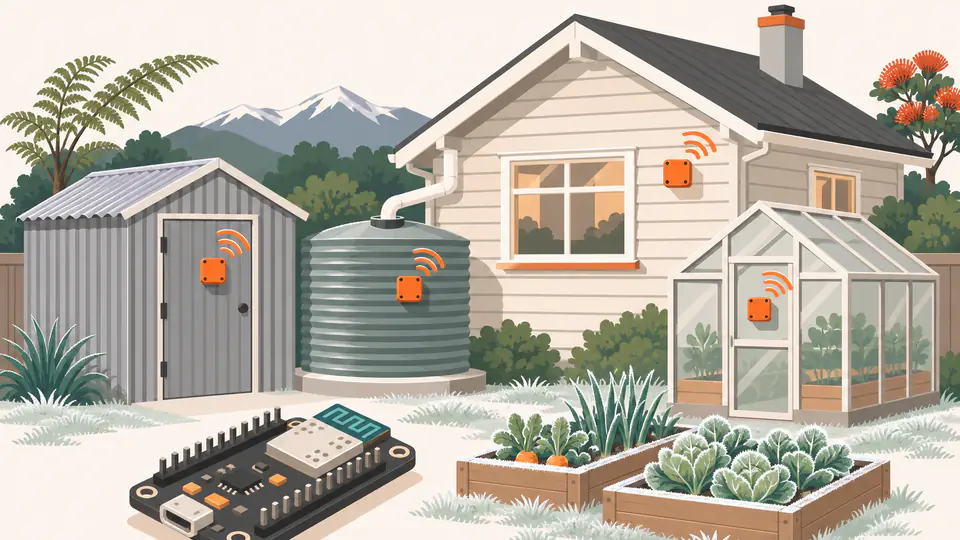
The best first projects solve a small problem you actually have. These seven are chosen for New Zealand conditions: damp winters, tank water, frosty mornings and sheds a long way from the router.
Each one pairs an ESP32-S3 board with a printed PETG part, because a project that lives in a case is a project that keeps running. Every idea lists what the board does, what to print and what you would need to source elsewhere. We stock the ESP32-S3 boards and accessories and the PETG filament; sensors come from an electronics retailer.
| Project | Sensor to source | Good first project? |
|---|---|---|
| Filament dry-box monitor | Humidity sensor | Yes |
| Damp and mould watch | Humidity sensor | Yes |
| Garage door or gate status | Magnetic reed switch | Yes |
| Frost alert | Waterproof temperature probe | Yes |
| Rainwater tank level monitor | Waterproof distance or pressure sensor | Intermediate |
| Home automation sensor node | Your choice | Intermediate |
| Voice assistant dock and add-on | None to start | Intermediate |
Before you start: three NZ notes
Stay on low voltage. Everything here runs from USB power or a small battery. Mains electrical work is regulated in New Zealand and is generally a job for a licensed electrician. To switch a mains appliance, use a certified smart plug, not a bare relay board.
Plan for the weather. A printed case is not waterproof by itself, and parts in strong sun for long periods may need a UV-resistant material or paint. Mount outdoor electronics under cover with openings facing down, and read why we prefer PETG in Auckland’s climate for where PETG fits.
Check the signal first. A steel shed, a concrete tank or foil-backed insulation can stop Wi-Fi from reaching a board that works perfectly on your desk. Measure before you build anything permanent: our guide to ESP32-S3 Wi-Fi range in a 3D printed case includes a signal-logging sketch.
1. Filament dry-box monitor
The problem: desiccant fills up silently, and damp PETG strings.
What the board does: reads a humidity sensor inside the box, shows green, amber or red on its on-board light and serves the reading on a web page.
What to print: a vented sensor pod and a board tray.
This one has a full write-up, including wiring and a complete sketch: build a filament dry-box humidity monitor.
2. Damp and mould watch
The problem: a wardrobe, a caravan, a bach or the back of a garage gets damp for weeks before anyone notices.
What the board does: logs temperature and humidity through the day and flags when the air stays damp for a long stretch. The same sensor and wiring as the dry-box monitor will do. For a spot without power, put the board into deep sleep between readings so a battery lasts.
What to print: a slim vented wall pod. Keep the sensor away from the board’s own warmth, and away from direct sun.
3. Garage door or gate status
The problem: was the garage door left open?
What the board does: reads a magnetic reed switch. The switch goes on the frame, the magnet on the door, and the board reports open or closed to a web page or your home automation system. The wiring is two wires and no soldering on the board.
What to print: a switch bracket and a magnet holder that set the gap between them. This is a good exercise in printing to a measured fit.
Sense the door only. Do not connect anything to the door opener’s own wiring.
4. Frost alert
The problem: a frost is forecast, but what matters is the temperature at your seedlings or in your greenhouse.
What the board does: reads a waterproof temperature probe at plant height and sends an alert when it falls below the threshold you set, through a notification service or your home automation system.
What to print: a small louvred shield that keeps rain and direct sun off the probe while letting air through, plus a stake clip. Light-coloured PETG stays cooler in the sun.
5. Rainwater tank level monitor
The problem: if your home is on tank water, a slow leak or a dry month shows up as an empty tank.
What the board does: measures the distance from the lid down to the water with a waterproof ultrasonic sensor, or the depth with a pressure sensor, and turns it into a percentage. Readings a few times a day are enough, which makes deep sleep and a battery or small solar panel practical.
What to print: a sensor mount for the tank lid and a covered box for the board.
Two cautions. First, many ultrasonic sensors run at 5 V, while ESP32-S3 pins work at 3.3 V, so choose a 3.3 V sensor or add a level shifter. Second, tanks are often a long way from the house. If the signal is weak, a board with an antenna connector can use an external antenna such as our 5dBi FPC antenna, mounted clear of the tank.
6. Home automation sensor node
The problem: you want several sensors around the house reporting to one place, without writing a new program for each.
What the board does: runs ESPHome, open-source firmware that turns a short configuration file into a sensor node for Home Assistant. One board can report temperature, humidity, a door switch and a button at the same time.
What to print: a wall or DIN-rail case. With several sensors on one board, a 44-pin terminal breakout board keeps the wiring serviceable: each sensor lead goes under a screw. Check the breakout against your board’s pin layout before fitting.
7. Voice assistant dock and add-on
The problem: you would like a desk gadget that listens and talks, without building the audio hardware yourself.
What the board does: the assembled ESP32-S3 Wi-Fi AI voice assistant already combines a display, speaker and rechargeable battery in a clear 41 × 41 × 30 mm enclosure, and has a spare serial connection for hardware projects. What you can do over that connection, and which voice features and services are available, depends on the firmware you configure.
What to print: an angled dock with a cable channel is a satisfying first design, because there is only one box to measure. From there, a second ESP32-S3 board connected to the spare serial port can act on simple messages, such as switching a light strip.
How to build these faster with AI
All seven follow the same pattern: read a sensor, decide something, report it. That is the kind of firmware an AI coding agent writes well, provided it can build the code and read the board’s output. Two guides in this series cover the method:
- Write, flash and debug ESP32-S3 firmware with Claude Code sets up the build, upload and serial-check loop.
- Design a PETG enclosure with AI and OpenSCAD does the same for the printed parts.
A useful first request describes the outcome, not the code: “read the reed switch on GPIO5, report open or closed on a web page, and add a self-test line that confirms the pin reads correctly.”
What to order
Most of these projects start from the same short list:
- An ESP32-S3 N16R8 development board with pre-soldered headers. If it is your first, the getting-started guide covers setup.
- A USB data cable.
- A roll of PETG. One 1kg roll is enough for many small enclosures. Choose a 1kg PETG refill if you already have a compatible reusable spool, or pick a roll with a spool from the full PETG range.
Boards and filament can go in the same order, with New Zealand delivery or free pickup in Torbay, Auckland.
How this guide was put together. It was drafted with AI assistance as a list of project ideas. Apart from the dry-box monitor’s sketch, which was compiled before publishing, these are outlines and not tested builds. Check each part’s voltage and wiring requirements before connecting it. This article is not a current stock list: check the ESP32-S3 range and the live PETG catalogue for current products, prices and stock.